Is Dry Ice Blasting Safe for Cars?
Dry ice blasting can be a safe, controlled way to clean a car when it is done correctly. This honest guide covers both sides of the question – is it safe for the vehicle, and is it safe for people – including paint, PPE, CO2 and when to avoid it.
Published
Quick answer: is dry ice blasting safe for cars?
Dry ice blasting can be safe for cars when it is carried out correctly by a trained and experienced operator.
It is often safer than pressure washing for sensitive areas because it does not introduce water. It is often safer than sandblasting for complete vehicles because it does not use abrasive media and does not leave sand or grit trapped in seams or cavities.
However, dry ice blasting is not risk-free.
It uses extremely cold solid carbon dioxide pellets, compressed air and specialist blasting equipment. The process requires PPE, ventilation, pressure control, masking and a proper understanding of automotive materials. For the full process, read what is dry ice blasting? and how dry ice blasting works on cars.
For car owners, the important point is this: dry ice blasting is safe when the vehicle is inspected, the right areas are protected and the operator knows how to adjust the process around paint, rubber, plastics, wiring, engine bays, underseal and older materials.
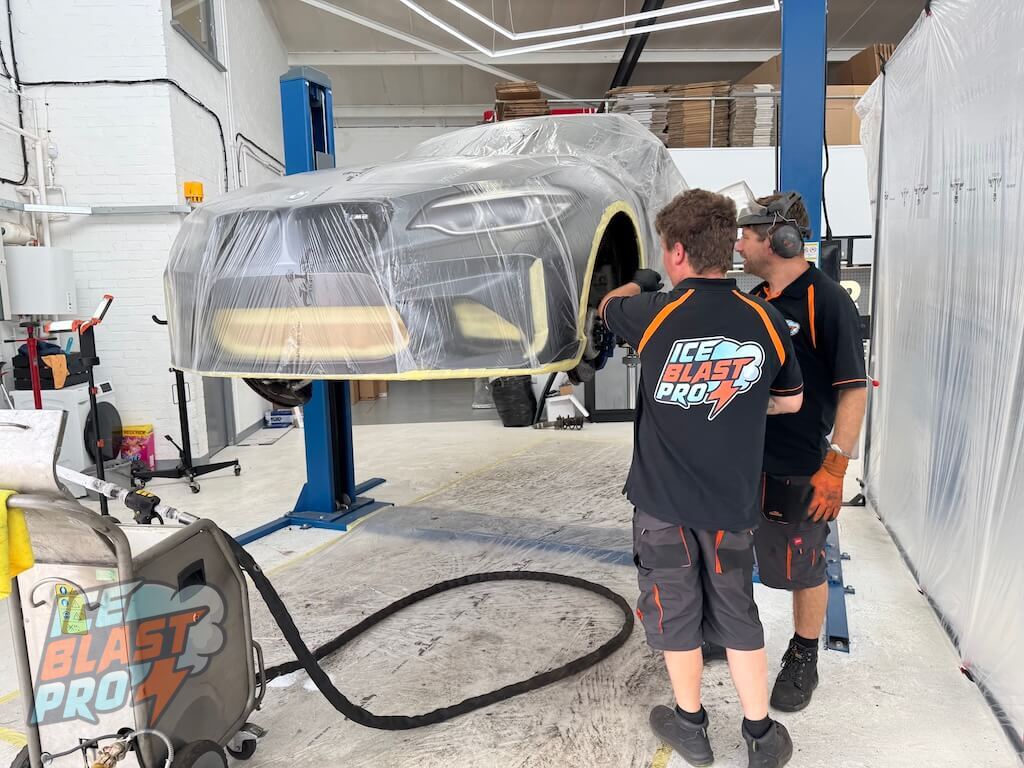
Is dry ice blasting dangerous?
Dry ice blasting can be dangerous if it is used incorrectly.
The main risks are:
- cold burns from touching dry ice
- CO2 build-up in poorly ventilated spaces
- noise exposure
- flying debris
- incorrect pressure around delicate car parts
- lifting weak paint or failed coatings
- poor handling or storage of dry ice
- using the process without proper PPE
In a professional workshop, these risks are controlled through training, PPE, ventilation, safe handling and correct technique. The process itself is not the problem. Poor control is the problem.
Is dry ice cleaning good for a car?
Yes, dry ice cleaning can be very good for a car when used in the right areas. It is particularly useful for:
- underbodies
- wheel arches
- engine bays
- suspension components
- gearbox casings
- subframes
- classic cars
- performance cars
- prestige vehicles
- restoration projects
It is less suitable for basic exterior washing, normal interior valeting or jobs where a simple detailing method would achieve the same result. Dry ice blasting is most valuable when the aim is to clean, inspect and preserve the vehicle, as part of underbody preservation or engine bay dry ice cleaning.
Does dry ice blasting damage car paint?
Dry ice blasting should not damage sound automotive paint when carried out correctly with the right pressure, nozzle, distance and technique.
However, loose paint, weak lacquer, cracked coatings, old underseal, failing wax or damaged finishes may lift during cleaning. That does not always mean the blasting caused the problem. In many cases, it means the coating was already weak and the process has revealed it.
On valuable, classic or older vehicles, the operator should always inspect the surface first and adjust the process to the condition of the paint or coating.
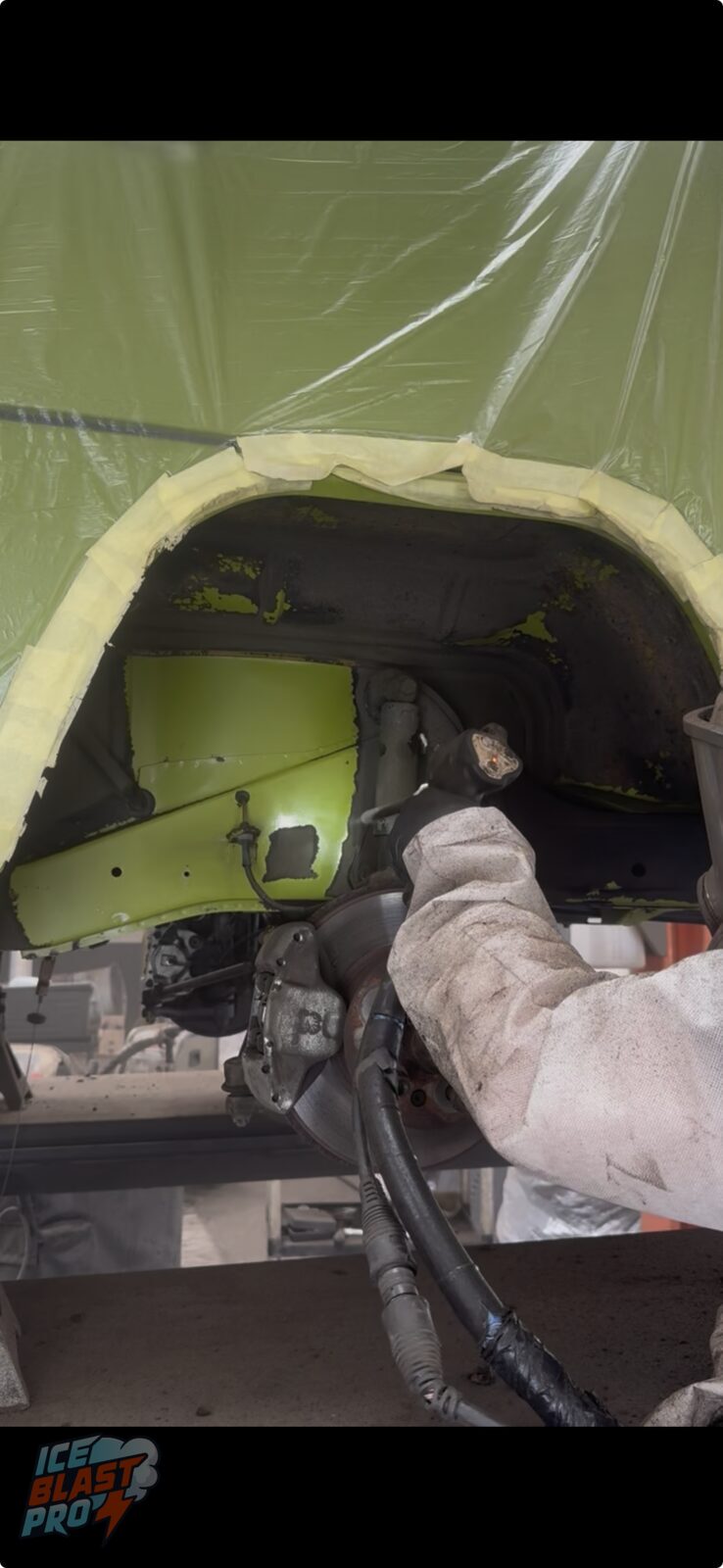
Can dry ice blasting damage a car?
Yes, if it is used incorrectly. Potential vehicle risks include:
- lifting loose paint
- removing weak coatings
- damaging fragile labels
- affecting brittle plastics
- disturbing loose trim
- exposing weak underseal
- damaging rubber or aged materials if treated too aggressively
- using too much pressure on delicate areas
- failing to protect sensitive parts
This is why dry ice blasting should not be treated as a one-setting process. A chassis section, painted wheel arch, engine bay label, rubber hose, aluminium suspension arm and underbody coating all need different care.
What parts of a car are usually safe to dry ice blast?
With the right technique, dry ice blasting can be used on many areas, including:
- underbodies
- wheel arches
- engine bays
- suspension arms
- subframes
- chassis rails
- gearbox casings
- differential casings
- brackets and fixings
- mechanical assemblies
- some painted areas
- some plastic and rubber areas with care
Every area should still be assessed first. See how we use it across a whole vehicle on our automotive dry ice blasting page.
What areas need extra caution?
Extra caution is needed around:
- fragile paint and old lacquer
- cracked coatings
- brittle plastics
- rubber hoses
- wiring looms and sensors
- engine bay labels, decals and stickers
- old underseal
- soft trim and adhesives
- previous repairs and aftermarket modifications
- thin metal and already weakened corrosion areas
A professional dry ice operator should reduce pressure, change nozzle, increase distance, mask, avoid or test these areas as needed.
Is dry ice blasting better than pressure washing?
For underbody preservation and engine bay cleaning, dry ice blasting is often better than pressure washing because it does not introduce water.
Pressure washing can remove dirt, but it can also force water into seams, cavities, connectors, old coatings and areas that are difficult to dry. Dry ice blasting is a dry process, which makes it more suitable before rust treatment, underbody protection or engine bay cleaning where moisture risk matters.
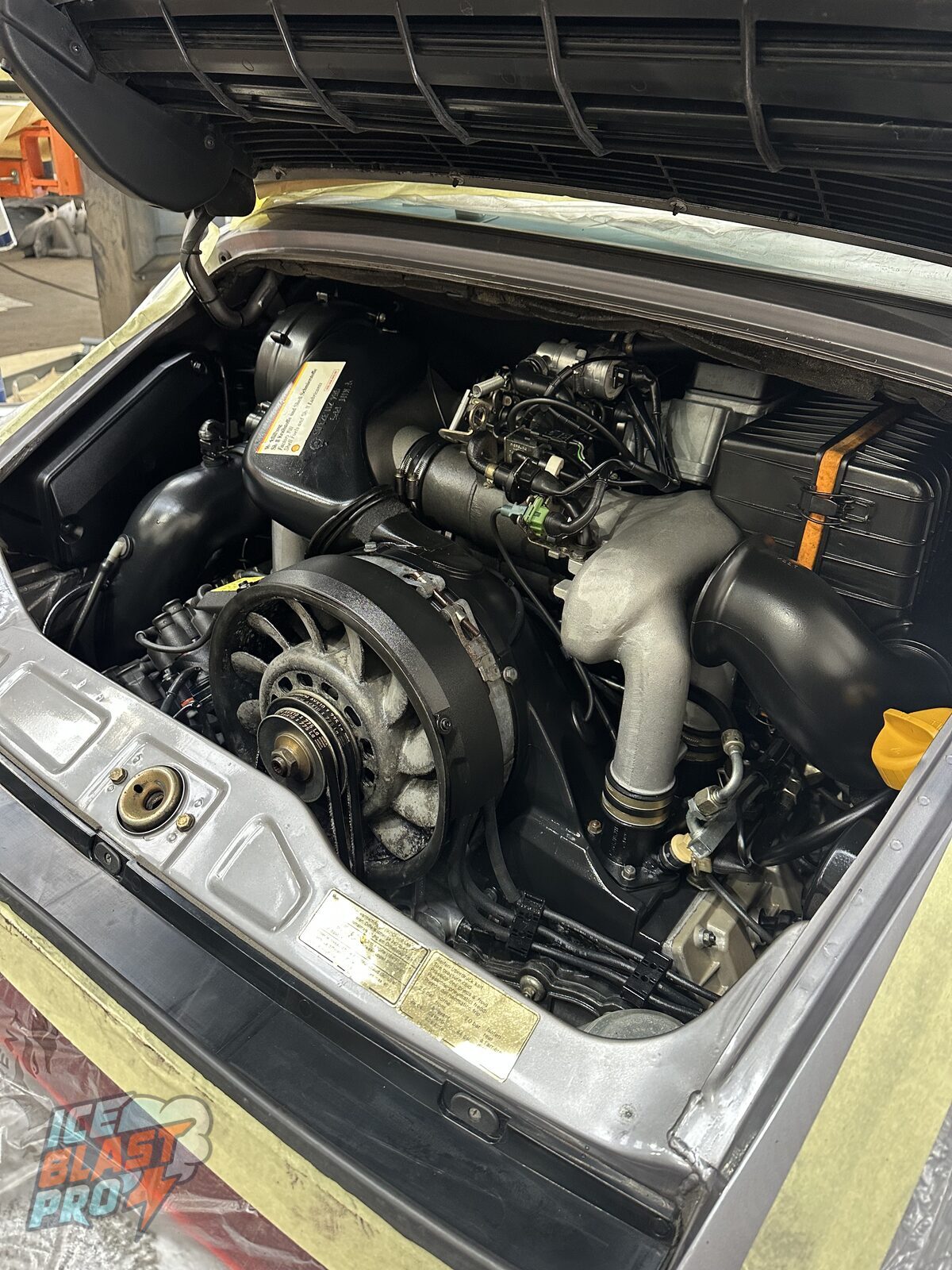
Is dry ice blasting safer than sandblasting?
For complete vehicles, underbodies, engine bays and original finishes, dry ice blasting is usually safer than sandblasting because it is non-abrasive when used correctly and leaves no blasting media behind.
Sandblasting is more aggressive and may be useful for removed parts, bare metal restoration or heavy stripping. But it can be too harsh for many assembled vehicle areas. For a full comparison, read dry ice blasting vs sandblasting.
Why is sandblasting sometimes described as forbidden?
The issue is usually traditional silica sand. Sand or substances containing free silica must not be used in direct pressure blasting because of the health risks from respirable crystalline silica dust.
Abrasive blasting as a wider process still exists with other media and controls. For vehicle owners, the practical point is that sandblasting should only be used where appropriate, with the right media, containment, PPE and operator experience.
What are the disadvantages of dry ice blasting?
The main disadvantages are:
- higher cost than basic cleaning
- specialist equipment required
- dry ice supply and storage
- noise
- ventilation requirements
- PPE requirements
- not always suitable for thick underseal or bitumen
- does not repair deep rust or holes
- may lift weak coatings
- result depends heavily on operator skill
Dry ice blasting is an excellent preparation method, but it is not the right answer for every surface or every car. For where rust is concerned, read can dry ice blasting remove rust?
What are the cons of dry ice blasting?
The practical cons are cost, access, dry ice supply, noise, ventilation and the need for trained operators.
For car owners, the biggest con is expectation. Dry ice blasting can make a car look dramatically cleaner, but it does not repair rust, fix weak metal, replace welding or guarantee that every coating can be removed quickly.
Is dry ice itself dangerous?
Dry ice can be dangerous if handled incorrectly. It is solid carbon dioxide at extremely low temperature. The main risks are:
- cold burns and frostbite
- CO2 gas build-up
- pressure build-up in sealed containers
- poor ventilation
- unsafe storage
- unsafe transport
Dry ice should always be handled with insulated gloves or suitable tools and stored in a ventilated container, never an airtight one.
What are three things you should never do with dry ice?
Never:
- touch dry ice with bare hands
- store dry ice in an airtight container
- use or store large amounts in an enclosed, unventilated space
These are the three most important rules for general dry ice safety.
What happens if you touch dry ice for one second?
Touching dry ice even briefly can be painful and may cause a cold burn depending on skin sensitivity and contact time. Longer contact can cause more serious cold injury.
Dry ice should always be handled with insulated gloves or suitable tools.
Do you need gloves to handle dry ice?
Yes. Dry ice should be handled with insulated gloves or suitable tools. Normal thin gloves may not provide enough protection.
Technicians should also use eye protection and suitable PPE during blasting because of cold pellets, compressed air, debris and noise.
What PPE is needed for dry ice blasting?
PPE depends on the job, but dry ice blasting usually requires:
- insulated gloves for handling dry ice
- eye protection or face protection
- hearing protection
- suitable workwear
- respiratory or ventilation controls where required
- safe footwear
- risk assessment for the working environment
For commercial work, PPE should be part of a wider safe system of work, not the only safety measure.
Are the fumes from dry ice harmful?
Dry ice turns into carbon dioxide gas.
Carbon dioxide is not toxic in the same way as a chemical poison, but it can displace oxygen in enclosed or poorly ventilated spaces. At higher concentrations, CO2 itself can also cause symptoms. This is why ventilation matters during dry ice blasting, storage and transport.
Does dry ice turn into carbon monoxide?
No.
Dry ice is solid carbon dioxide, or CO2. It sublimates into carbon dioxide gas, not carbon monoxide. Carbon monoxide is a different gas and is associated with incomplete combustion, not dry ice sublimation.
Does dry ice have a smell?
Dry ice itself does not normally have a strong smell. If there is a smell during dry ice cleaning, it is usually from the contamination being removed, not the dry ice itself.
The lack of smell does not mean CO2 build-up is safe. Carbon dioxide can still accumulate in poorly ventilated spaces.
Is dry ice safe indoors?
Dry ice can be used indoors only with proper ventilation, safe storage and appropriate controls. Large quantities of dry ice should not be used or stored in small, enclosed or poorly ventilated spaces.
For dry ice blasting, the workshop should have suitable ventilation and the operator should understand CO2 risk.
How much ventilation do you need for dry ice?
There is no single ventilation answer that applies to every job. The requirement depends on:
- amount of dry ice
- size of the room
- airflow
- blasting duration
- storage method
- number of people present
- whether the area is enclosed
- whether CO2 monitoring is used
A professional workshop should assess ventilation as part of its safe working process.
How much dry ice is toxic to humans?
There is no simple safe number of kilograms because the risk depends on the space, ventilation and time. A small amount of dry ice in a small sealed space can be more dangerous than a larger amount in a well-ventilated workshop.
The danger comes from CO2 concentration in the air, not just the weight of dry ice. That is why dry ice should never be stored or used in an enclosed, unventilated space.
What are the symptoms of dry ice exposure or CO2 build-up?
Symptoms of excessive carbon dioxide exposure may include:
- headache
- dizziness
- confusion
- shortness of breath
- nausea
- unusual tiredness
- rapid breathing
- feeling faint
- loss of consciousness in severe cases
Anyone who feels unwell after possible dry ice or CO2 exposure should move to fresh air immediately and seek medical advice if symptoms continue or are severe.
What should you do after inhaling dry ice fumes?
Move to fresh air immediately.
If symptoms such as dizziness, headache, confusion, shortness of breath, nausea or feeling faint continue, seek medical advice. If someone collapses or appears seriously unwell, call emergency services. Do not enter an enclosed or poorly ventilated area to rescue someone unless it is safe to do so.
What is the "silent killer" in cars?
This can mean different things.
In car preservation, rust is often called a silent killer because it can develop underneath the vehicle, behind arch liners, under old coatings or inside seams before the owner sees visible signs. In safety terms, carbon monoxide is often described as a silent killer because it is difficult to detect without an alarm.
Dry ice does not produce carbon monoxide. Dry ice produces carbon dioxide.
What will destroy car paint fast?
Strong chemicals, brake fluid, bird droppings, poor washing methods, abrasive tools, incorrect polishing, harsh environmental exposure and neglect can all damage paint. Dry ice blasting should not damage sound paint when carried out correctly, but weak coatings or already damaged finishes may lift.
How long will dry ice last?
How long dry ice lasts depends on:
- quantity
- format
- storage container
- temperature
- airflow
- how often the container is opened
Pellets used for blasting sublimate faster than larger blocks because they have more exposed surface area. Questions such as how long a 10lb block lasts or how long 20kg lasts cannot be answered exactly without knowing storage conditions.
How much does dry ice cost?
The cost of dry ice depends on quantity, format, supplier, delivery and location. Questions such as how much 1kg or 30lb of dry ice costs vary by supplier and market conditions.
For dry ice blasting, the dry ice itself is only one part of the cost. The job also includes machinery, compressor output, labour, PPE, ventilation, access, masking, inspection and experience.
How much does dry ice blasting cost in the UK?
Dry ice blasting cost depends on the vehicle, access, contamination, condition and scope. Targeted automotive cleaning may start from a few hundred pounds. Full underbody and preservation projects usually move into the low-to-mid four figures.
For detailed pricing, see our dry ice blasting cost guide.
What should car owners ask before booking dry ice blasting?
Before booking dry ice blasting, ask:
- Have you worked on cars like mine before?
- Do you inspect the vehicle before blasting?
- Do you remove wheels, liners or trays where needed?
- How do you protect paint, rubber, wiring and plastics?
- What areas will you avoid or treat carefully?
- Do you document the condition before and after?
- What happens if rust or failed coatings are found?
- Is rust treatment or protection included?
- Do you have suitable ventilation and PPE?
- What is included in the quoted price?
A good workshop should be able to explain the process clearly.
How IceBlastPro keeps dry ice blasting safe
At IceBlastPro, dry ice blasting is carried out as part of an inspection-led process. Depending on the vehicle and the job, this may include:
- pre-inspection
- bodywork protection
- wheels removed where required
- arch liners and trays removed where required
- masking sensitive areas
- selecting the correct nozzle
- controlling pressure
- adjusting technique by material
- careful work around rubber, plastics, wiring and labels
- ventilation and PPE
- documentation
- rust treatment where required
- protective coating or cavity wax where needed
The goal is not just to clean the vehicle. The goal is to clean it safely, reveal its true condition and protect it properly.
Final thoughts
Dry ice blasting can be safe for cars, but only when it is treated as a specialist process. It is not just cold air cleaning. It uses extremely cold dry ice pellets, compressed air and specialist equipment.
For vehicles, the safety comes from control: inspection, masking, pressure settings, nozzle choice, distance, ventilation and operator experience. For people, the safety comes from PPE, ventilation, safe dry ice handling and understanding CO2 risk.
Used properly, dry ice blasting is one of the safest ways to clean and inspect sensitive automotive areas without water or abrasive media. Used carelessly, it can create risks like any specialist process. That honesty is what helps owners make the right decision.
Common questions
Is dry ice blasting safe for cars?
Yes, dry ice blasting can be safe for cars when carried out correctly by an experienced operator using the right pressure, nozzle, masking, ventilation and PPE.
Is dry ice blasting dangerous?
It can be dangerous if handled incorrectly. The main risks are cold burns, CO2 build-up, noise, flying debris and damage from poor technique.
Does dry ice blasting damage car paint?
It should not damage sound paint when used correctly, but loose paint, failed coatings or weak finishes may lift.
Is dry ice cleaning good for a car?
Yes, when used in the right areas. It is especially useful for underbodies, wheel arches, engine bays, suspension parts and preservation work.
What are the disadvantages of dry ice cleaning?
The main disadvantages are cost, noise, specialist equipment, dry ice supply, ventilation needs and the fact that it does not repair deep rust or damaged surfaces.
What are the cons of dry ice blasting?
Cost, access, dry ice supply, noise, ventilation and the need for a skilled operator are the main cons.
Is dry ice blasting better than pressure washing?
For underbody preservation and engine bay cleaning, often yes, because it does not introduce water.
Which is better, sandblasting or dry ice blasting?
Dry ice blasting is usually better for cleaning and preservation. Sandblasting is better for aggressive stripping of suitable removed parts.
Why is sandblasting forbidden now?
Traditional silica sand must not be used in direct pressure blasting because of silica dust risks. Other abrasive blasting methods may still be used with proper controls.
What are three things you should never do with dry ice?
Never touch dry ice with bare hands, never store it in an airtight container and never use or store large amounts in an enclosed space without ventilation.
What happens if you touch dry ice for one second?
It can cause pain and may result in a cold burn depending on contact time and skin sensitivity.
Do I need gloves to handle dry ice?
Yes. Dry ice should be handled with insulated gloves or suitable tools.
What PPE is needed for dry ice blasting?
Insulated gloves, eye or face protection, hearing protection, suitable workwear and ventilation controls are normally required. The exact PPE depends on the job and risk assessment.
Are the fumes from dry ice harmful?
Dry ice becomes carbon dioxide gas. CO2 can displace oxygen in enclosed spaces and may cause symptoms if levels become too high.
Does dry ice turn into carbon monoxide?
No. Dry ice turns into carbon dioxide gas, not carbon monoxide.
Does dry ice have a smell?
Dry ice itself does not normally have a strong smell. The absence of smell does not mean CO2 levels are safe.
Is dry ice safe indoors?
Only with proper ventilation and safe handling. Large amounts should not be used or stored in enclosed, poorly ventilated spaces.
How much ventilation do you need for dry ice?
It depends on the amount of dry ice, space size, airflow, blasting time and storage method. A professional workshop should assess ventilation before use.
How much dry ice is toxic to humans?
There is no simple kilogram amount. The risk depends on CO2 concentration in the air, which depends on the amount of dry ice, space size and ventilation.
What are the symptoms of dry ice exposure?
Symptoms can include headache, dizziness, confusion, shortness of breath, nausea, tiredness, rapid breathing or feeling faint.
What should you do after inhaling dry ice fumes?
Move to fresh air immediately. Seek medical advice if symptoms continue or are severe. Call emergency services if someone collapses or is seriously unwell.
How long will a 10lb block of dry ice last?
It depends on storage, temperature and insulation. Blocks usually last longer than pellets because they have less exposed surface area.
How long will 20kg of dry ice last?
It depends on format, storage and temperature. Dry ice pellets used for blasting sublimate faster than larger blocks.
How much is 1kg of dry ice?
The price varies by supplier, format, quantity, delivery and location.
Want to know if dry ice blasting is safe for your car?
Send us photos or a short video of your underbody, engine bay or the area you want cleaned and we'll advise whether dry ice blasting is suitable – and whether the vehicle needs rust treatment, underbody protection, cavity wax or a more targeted approach.
Get Instant Quote