Can Dry Ice Blasting Remove Rust? The Honest Answer for Car Owners
Dry ice blasting can remove loose surface rust and contamination, but it does not repair deep corrosion, pitting, weak metal or holes. This guide explains exactly what it can and cannot remove, when rust treatment is needed, and how proper underbody preservation works.
Updated
Quick answer: can dry ice blasting remove rust?
Dry ice blasting can remove loose surface rust, road salt, oil, grease, dirt and failing coatings from a car underside. It can also expose hidden corrosion that has been sitting beneath old underseal, wax or contamination.
But dry ice blasting does not repair deep corrosion, pitted metal, holes, weak sections or structural rust. It is not a magic rust remover. The most accurate way to describe it is this: it is an excellent preparation and inspection method. It cleans the surface, reveals the true condition of the metal and shows what rust treatment, laser cleaning, welding or protection may be needed next.
For car underbodies, dry ice blasting is often the first stage of proper underbody preservation, not the final answer to rust.
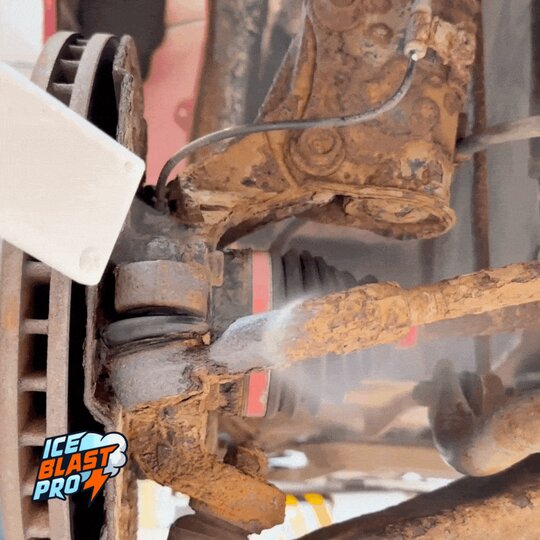
What dry ice blasting can remove
Dry ice blasting can remove or reduce:
- loose surface corrosion
- road salt and mud
- oil, grease and dirt
- old wax and loose paint
- loose underseal and failing coatings
- contamination around seams, brackets and suspension components
This is useful because rust is often hidden beneath dirt, salt, grease, underseal or old wax. Once those layers are removed, the real condition of the vehicle can finally be seen.
What dry ice blasting cannot remove
Dry ice blasting cannot:
- rebuild weak metal
- fill holes or repair perforated metal
- reverse structural corrosion
- remove deep pitting completely
- replace welding
- permanently stop rust by itself
- convert active rust into a stable surface
- act as a final protective coating
This is where expectations matter. A vehicle can look dramatically cleaner after dry ice blasting, but if deeper corrosion is present, it still needs proper rust treatment and protection.
Does dry ice blasting work on rust?
Yes, dry ice blasting works well on loose surface corrosion and contamination around rust. It is especially useful when the goal is to clean the area and reveal what is happening underneath.
However, it does not work like sandblasting, grinding, chemical rust remover or laser cleaning. It is less aggressive, which is one of the reasons it is useful for automotive preservation. For a car underside, the aim is often not to attack the metal as aggressively as possible. It is to clean the surface safely, preserve sound factory finishes where possible and identify what needs further treatment.
Does dry ice blasting take off rust?
Dry ice blasting can take off loose surface rust and surface-level corrosion, but it will not fully remove deeper corrosion that has bonded into the metal or caused pitting.
If the rust has only developed lightly on the surface, dry ice blasting may remove a noticeable amount of it and bring the area back to a treatable surface. If the rust has gone deeper, the process will expose the problem rather than remove it completely – and that exposure is still valuable, because it allows the next stage of rust treatment, stabilisation or protection to be done properly.
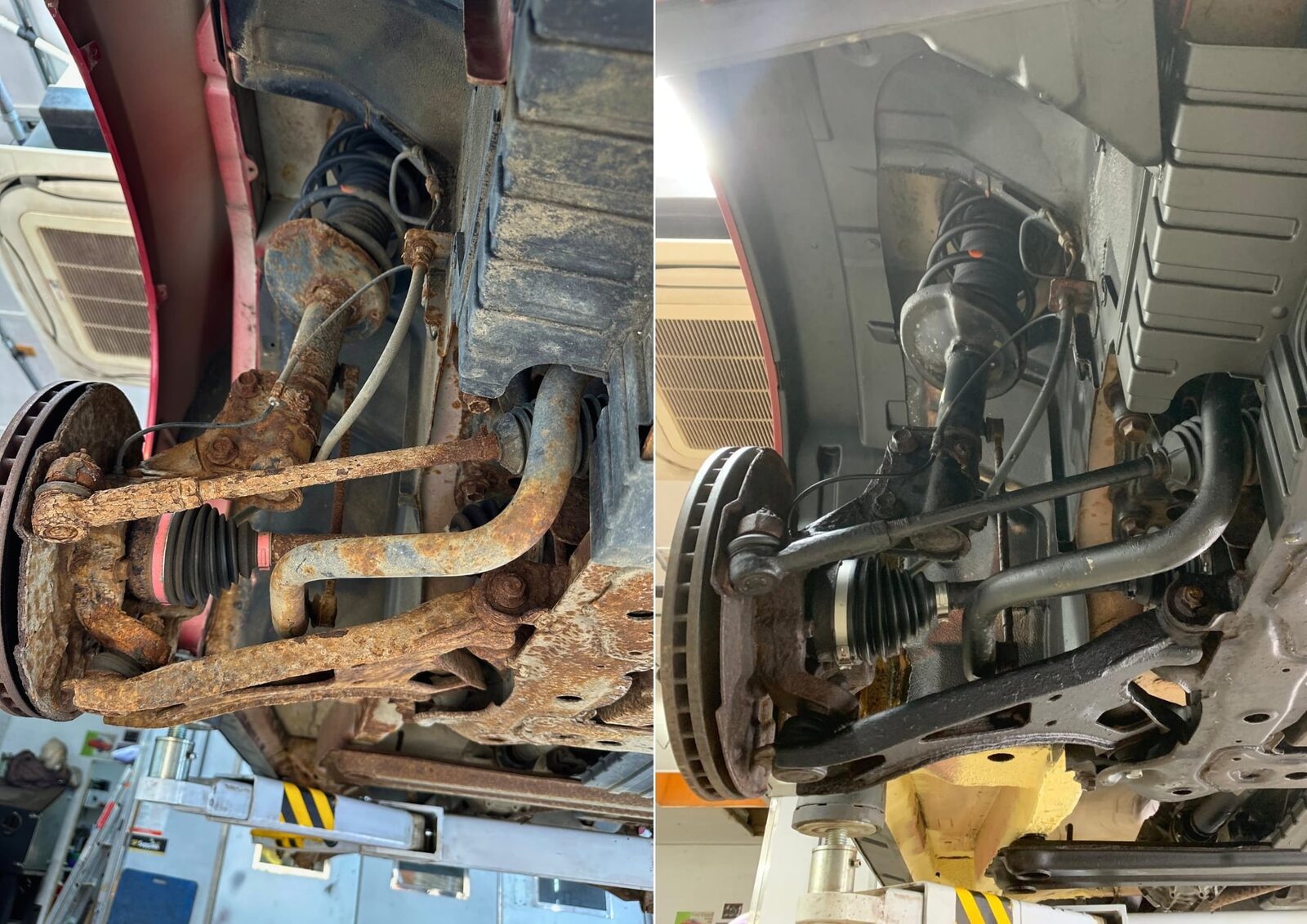
Why dry ice blasting is useful for rust treatment
Dry ice blasting is useful for rust treatment because it creates a clean, dry surface before any chemical, coating or repair work begins.
- Compared with pressure washing, it does not introduce water into seams, cavities or vulnerable areas.
- Compared with wire wheeling, it is less messy and can reach more complex shapes.
- Compared with sandblasting, it is less aggressive and does not leave abrasive media trapped in seams or cavities.
The value is in preparation. Rust treatment works better when the surface has been cleaned properly first.
What does dry ice blasting remove?
Dry ice blasting can remove road salt deposits, oil, grease, road grime, loose surface corrosion, failing underseal, bitumen coatings and dirt trapped in seams, overlaps and hard-to-reach areas.
Because dry ice blasting is non-abrasive, it does not grind the metal in the same way as sandblasting or aggressive media blasting. When used correctly, it can clean and expose the surface while preserving sound factory finishes, original coatings and delicate areas that should not be stripped unnecessarily.
This makes it particularly useful for preservation-focused work, where the objective is not to make everything bare metal, but to clean the underside, reveal the true condition and prepare the vehicle for correct rust stabilisation and protection.
If deeper corrosion, pitting, holes or structural rot are found, dry ice blasting alone will not fix those issues. Those areas may require rust stabilisation, laser cleaning, mechanical preparation, welding, panel repair or replacement before any coating is applied.
Does dry ice blasting remove factory finishes or original coatings?
Dry ice blasting is designed to remove contamination without stripping sound factory finishes unnecessarily.
However, loose, failing, cracked or poorly adhered coatings may lift during the process. This is usually a useful result, because it reveals areas where moisture may already have reached the metal underneath.
A sound original coating should normally remain in place. A failed coating should not be protected over as if it is still doing its job.
Can rust be stopped once it starts?
Early-stage rust can often be stabilised if it is treated correctly.
Loose corrosion and contamination must be removed first. Any remaining corrosion should then be treated with the correct rust stabiliser, converter or preparation method before the area is sealed with an appropriate protection system.
However, rust cannot be “reversed”. If the metal is deeply pitted, weakened, perforated or rotten, it may need welding or replacement. Simply coating over active rust will not stop the problem long term.
What is a rust converter?
A rust converter, also called a rust stabiliser or rust neutraliser, is a chemical treatment applied to prepared corroded metal.
It reacts with remaining corrosion and helps convert it into a more stable surface that can be primed, coated or protected. It does not rebuild missing metal, repair structural weakness or replace proper preparation.
Rust converters work best when loose rust, dirt, salt and failed coatings have been removed first.
Surface rust vs deeper corrosion vs rot
Surface rust is the early stage. It usually appears as light orange or brown staining on exposed metal. Dry ice blasting can often remove or reduce some of this loose corrosion and expose the surface underneath.
Deeper corrosion is more serious. It may involve pitting, scaling or weakened metal. Dry ice blasting may clean around it and expose it, but further treatment is normally needed.
Rot is severe corrosion. The metal has become weak, perforated or structurally compromised. Dry ice blasting cannot fix rot. Welding, replacement panels or fabrication may be required before protection is applied. Understanding the difference matters because not all rust can be treated the same way.
What happens after dry ice blasting reveals rust?
Once dry ice blasting reveals rust, the next step depends on severity:
- light surface corrosion may be stabilised and protected
- more active corrosion may need a rust converter, rust stabiliser or targeted chemical treatment
- pitted corrosion may benefit from laser cleaning or more focused preparation
- weak metal, holes or structural corrosion may need welding or replacement
Once the surface is clean and stable, the vehicle can be protected with the right system. Depending on the vehicle and intended use, that may include clear underbody protection, black underbody coating, cavity wax or lanolin-based protection such as Lanoguard, Dinitrol or Bilt Hamber.
Is dry ice blasting better than pressure washing for rust?
For rust inspection and underbody preservation, dry ice blasting is usually better than pressure washing because it does not introduce water. Pressure washing can remove surface dirt, but it can also push water into seams, cavities, old coatings and vulnerable areas, which is not ideal if the next stage is rust treatment or coating.
Dry ice blasting leaves the surface dry, which makes it more suitable before rust stabilisation and protection. See our full dry ice blasting vs pressure washing comparison.
Is dry ice blasting as good as sandblasting for rust?
It depends on the goal. Sandblasting is more aggressive and can remove rust more heavily, especially on removed parts or bare-metal restoration projects. But it is abrasive and can damage thin metal or original finishes, and can leave media trapped in seams and cavities.
Dry ice blasting is better for careful cleaning, inspection and preservation of complete vehicles, undersides, engine bays and high-value cars. For heavy rust removal on removed parts, abrasive blasting may be suitable; for in-situ car underside preservation, dry ice blasting followed by rust treatment or laser cleaning is often more controlled. Read the full dry ice blasting vs sandblasting comparison.
Is laser cleaning better than dry ice blasting for rust?
Laser cleaning for pitted corrosion can be better for targeted pitted corrosion, seams, edges and areas where rust has gone deeper into the metal. Dry ice blasting is better for removing road grime, grease, salt, oil, dirt, loose corrosion and old coatings across larger underbody areas.
In preservation work, the two methods often work together. Dry ice blasting cleans and exposes the underside; laser cleaning can then be used on the specific corrosion areas that need more focused treatment.
What do professionals use to remove car rust?
Professionals choose the method based on the severity and location of the rust. Methods can include dry ice blasting, laser cleaning, mechanical preparation, wire wheeling, sanding, abrasive blasting, chemical rust removers, rust converters, rust stabilisers, welding, replacement panels, protective coatings and cavity wax.
A proper professional process starts with inspection. You cannot choose the right method until you know whether the rust is surface-level, pitted, structural or hidden under old coatings.
What permanently stops rust?
Nothing permanently stops rust in every situation. Rust control depends on removing contamination, treating active corrosion, repairing weak metal, protecting exposed surfaces, applying cavity wax where required, using and storing the vehicle sensibly, and inspecting it over time.
A good preservation system can dramatically reduce the risk of future rust, but no coating or rust treatment can guarantee that a car will never corrode again. For the bigger picture, see our car rust treatment and prevention guide.
How much does it cost to remove rust from a car?
The cost depends on the location, severity and method required. A small surface rust area may be relatively straightforward. Full underbody cleaning, rust treatment and protection can move into the low-to-mid four figures. Welding, replacement panels or structural work can cost significantly more.
The most accurate quote comes after photos, video or inspection, because rust is often hidden under old coatings, dirt or underseal. See our dry ice blasting cost guide and rust treatment service for more detail.
How IceBlastPro uses dry ice blasting for rust
At IceBlastPro, dry ice blasting is used as the first stage of a proper preservation process. We inspect the vehicle, protect the bodywork, remove wheels, liners and trays where required, dry ice blast the underside or selected areas, document what is revealed, treat corrosion where needed and apply suitable protection.
Depending on the vehicle, the next stage may include rust stabilisation, rust conversion, laser cleaning, welding or repair, clear protection, black underbody coating, cavity wax or engine bay coating. The goal is not to pretend dry ice blasting solves every rust problem – it is to reveal the true condition, treat the corrosion properly and protect the vehicle for long-term ownership.
Final thoughts
Dry ice blasting is extremely useful in the fight against rust, but not because it magically removes every trace of corrosion. Its real value is that it cleans the underside, removes loose corrosion and contamination, exposes hidden problems and gives the vehicle a proper foundation for rust treatment and protection.
For car owners, that honesty matters. If it is surface rust, dry ice blasting will remove or reduce it before treatment. If the rust is deeper, the blasting will reveal what needs to be done next. If the metal is weak or perforated, repair will be needed before protection. That is why the best rust work is not just blasting – it is inspection, cleaning, treatment, repair where required, protection and documentation.
Common questions
Can dry ice blasting remove rust?
Dry ice blasting can remove loose surface rust and contamination, but it does not remove deep pitting, repair weak metal or fix structural corrosion. It is best seen as a cleaning and preparation method, not a complete rust repair.
Can you remove rust with dry ice?
You can remove loose surface rust with dry ice blasting, but it should not be relied on as a complete rust removal method. Deeper corrosion still needs stabilisation, treatment or repair.
What is the best rust remover for cars?
There is no single best rust remover. The right method depends on whether the rust is surface-level, pitted, structural, hidden under coatings or on a removed part, which is why inspection comes first.
What removes rust immediately?
Aggressive methods such as grinding, abrasive blasting or strong chemicals can remove rust quickly, but they are not always suitable for complete vehicle undersides or delicate areas.
What fixes rust in a car permanently?
A lasting repair usually requires removing or stabilising the corrosion, repairing weak metal where required, protecting the surface and maintaining it over time. There is no one-product permanent fix for every rust problem.
What do mechanics use to remove rust?
Specialists may use wire wheels, sanding, grinders, chemical treatments, abrasive blasting, dry ice blasting, laser cleaning, rust converters, welding and protective coatings depending on the situation.
Can WD-40 remove rust from a car?
WD-40 may loosen light surface contamination and displace moisture, but it is not a proper rust treatment for car underbodies or structural corrosion.
Does vinegar remove rust from cars?
Vinegar may affect light rust on small removable items, but it is not a professional solution for vehicle underbody corrosion.
Can Coca-Cola remove rust?
Coca-Cola may affect light rust or staining in small situations, but it is not suitable for professional vehicle rust treatment.
Does toothpaste remove rust?
Toothpaste is not a proper rust remover for cars. Vehicle rust should be cleaned, assessed and treated with appropriate methods.
What removes rust but not paint?
There is no guaranteed method that removes rust without any risk to paint. Dry ice blasting can preserve sound finishes in some cases, but loose paint or failed coatings may lift.
Can rust be completely removed from a car?
Surface rust can sometimes be removed completely. Deeper corrosion may leave pitting or require repair, and severe rust may need welding or panel replacement.
How much does it cost to remove rust off a car?
It depends on the location and severity. Light surface treatment may be relatively simple, while full underbody rust treatment, protection or welding can move into the low-to-mid four figures or higher.
Is it worth fixing rust on a car?
It is worth fixing rust when the vehicle has enough value, condition or importance to justify the work. Early rust treatment is usually more cost-effective than waiting until structural repair is needed.
Can a body shop get rid of rust?
Yes, a body shop can repair rust, especially cosmetic or structural panel rust. Underbody rust may also need preservation-specific cleaning, treatment and protection.
Will insurance cover rust repair?
Usually not, because rust is normally treated as wear, age or corrosion rather than sudden accidental damage. Always check your own policy.
What are the disadvantages of dry ice blasting?
The main disadvantages are cost, specialist equipment, dry ice supply, noise, ventilation and PPE requirements, and the fact that it does not repair deep rust, holes or structural corrosion.
What are three things you should never do with dry ice?
Never touch it with bare hands, never store it in an airtight container, and never use or store large amounts in an enclosed space without ventilation.
Not sure whether your car has surface rust or something more serious?
Send us underside photos or a short video and we'll advise whether your vehicle needs dry ice blasting, rust treatment, laser cleaning, cavity wax, underbody protection or further inspection.
Get Instant Quote