How Does Dry Ice Blasting Work on Cars?
Dry ice blasting uses solid CO2 pellets, fired by compressed air, to lift dirt, grease, road salt, oil and failing coatings off a car. This practical guide explains how the process works on underbodies, wheel arches and engine bays, what it removes, whether it damages paint, how it compares with pressure washing, and where it fits in underbody preservation.
Published
Dry ice blasting, sometimes called dry ice cleaning, is one of the most useful preparation methods for car underbodies, wheel arches, engine bays, suspension components, subframes and complex mechanical assemblies. It cleans without adding water and without leaving sand or grit behind.
The most important point is this: dry ice blasting is not just about making a car look cleaner. In preservation work it is used to expose the true condition of the vehicle, so corrosion, failed coatings, oil contamination and hidden issues can be assessed before treatment or protection is applied.
This guide explains how the process works, what it can and cannot do, and how it sits alongside rust treatment, laser cleaning and underbody protection on classic, performance and prestige vehicles.
Quick answer: how does dry ice blasting work on cars?
Dry ice blasting uses small pellets of solid carbon dioxide, also known as dry ice, accelerated by compressed air. When the pellets hit the surface, they remove dirt, grease, road salt, oil, loose corrosion and some failing coatings through a combination of impact, extreme cold and sublimation.
On cars, it is mainly used for underbodies, wheel arches, engine bays, suspension components, subframes, chassis areas and complex mechanical assemblies. It is useful because it introduces no water, leaves no sand or grit behind, and can clean detailed areas without the same abrasion as traditional blasting methods.
What is dry ice blasting?
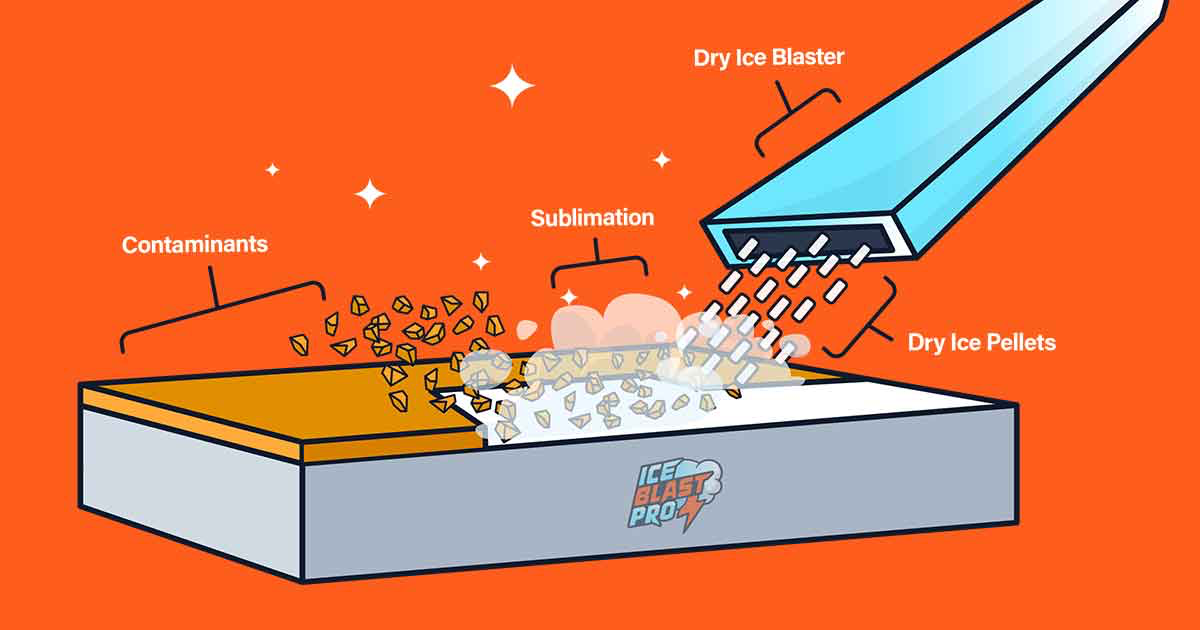
Dry ice blasting is a cleaning method that uses solid CO2 pellets fired through a blasting machine with compressed air. The pellets are extremely cold and turn directly from solid into gas when they hit a warmer surface. This means they do not melt into water and do not leave secondary blasting media behind.
For automotive work, that makes it especially useful around areas where water, sand, grit or chemicals may create problems. It can be used around underbodies, engine bays, suspension parts, wheel arches, subframes and mechanical assemblies when carried out with the correct pressure, nozzle and technique.
The science behind dry ice blasting
Dry ice blasting works through three main actions:
- Kinetic impact. The dry ice pellets hit the surface at speed and help break the bond between the contamination and the material underneath.
- Thermal shock. Dry ice is solid carbon dioxide, roughly −79°C (it sublimates at −78.5°C at normal pressure). When it contacts dirt, grease, wax, oil or brittle contamination, the sudden temperature change helps loosen the material from the surface.
- Sublimation. Dry ice turns directly from solid CO2 into gas, expanding around 800 times in volume. This rapid expansion helps lift contamination away without leaving water or grit behind.
These three effects work together. The result is a dry, controlled cleaning process that can remove contamination from detailed areas without the same residue or moisture issues as many traditional cleaning methods.
How the process works on a car
Automotive dry ice blasting is not just pointing a machine at the underside of a car. A proper process usually includes:
- Vehicle inspection
- Bodywork protection and wrapping
- Lifting the vehicle safely
- Removing wheels where required
- Removing arch liners, undertrays or access panels where needed
- Masking sensitive areas
- Setting the correct pressure and nozzle
- Dry ice blasting the selected areas
- Inspecting what has been revealed
- Treating corrosion where needed
- Applying protection if the vehicle is being preserved
- Documenting the process with photos or video
The best results come from the full process, not just the blasting itself.
What parts of a car can be dry ice blasted?
Dry ice blasting can be used on many automotive areas, including:
- Underbodies, floorpans and chassis rails
- Wheel arches and jacking points
- Suspension arms and subframes
- Engine bays, gearbox and differential casings
- Brackets, fixings and mechanical assemblies
- Selected plastic, rubber and painted areas when treated carefully
The operator must adjust the pressure and technique depending on the material. A heavy chassis section, a delicate engine bay label, a rubber component and a painted arch area should not all be treated in the same way.
What does dry ice blasting remove from cars?
Dry ice blasting can remove or reduce:
- Road salt, mud and dirt
- Oil, grease and wax
- Loose surface corrosion and loose paint
- Failing underseal and some coatings
- Some adhesives and old contamination around engine bays
It is especially useful where contamination is trapped around complex shapes, seams, brackets, suspension components and underbody areas. However, it is not magic. Some heavy coatings, thick bitumen, rubberised underseal, baked-on material or deeply bonded substances may need more time, test patches or additional methods.
Does dry ice blasting remove rust?
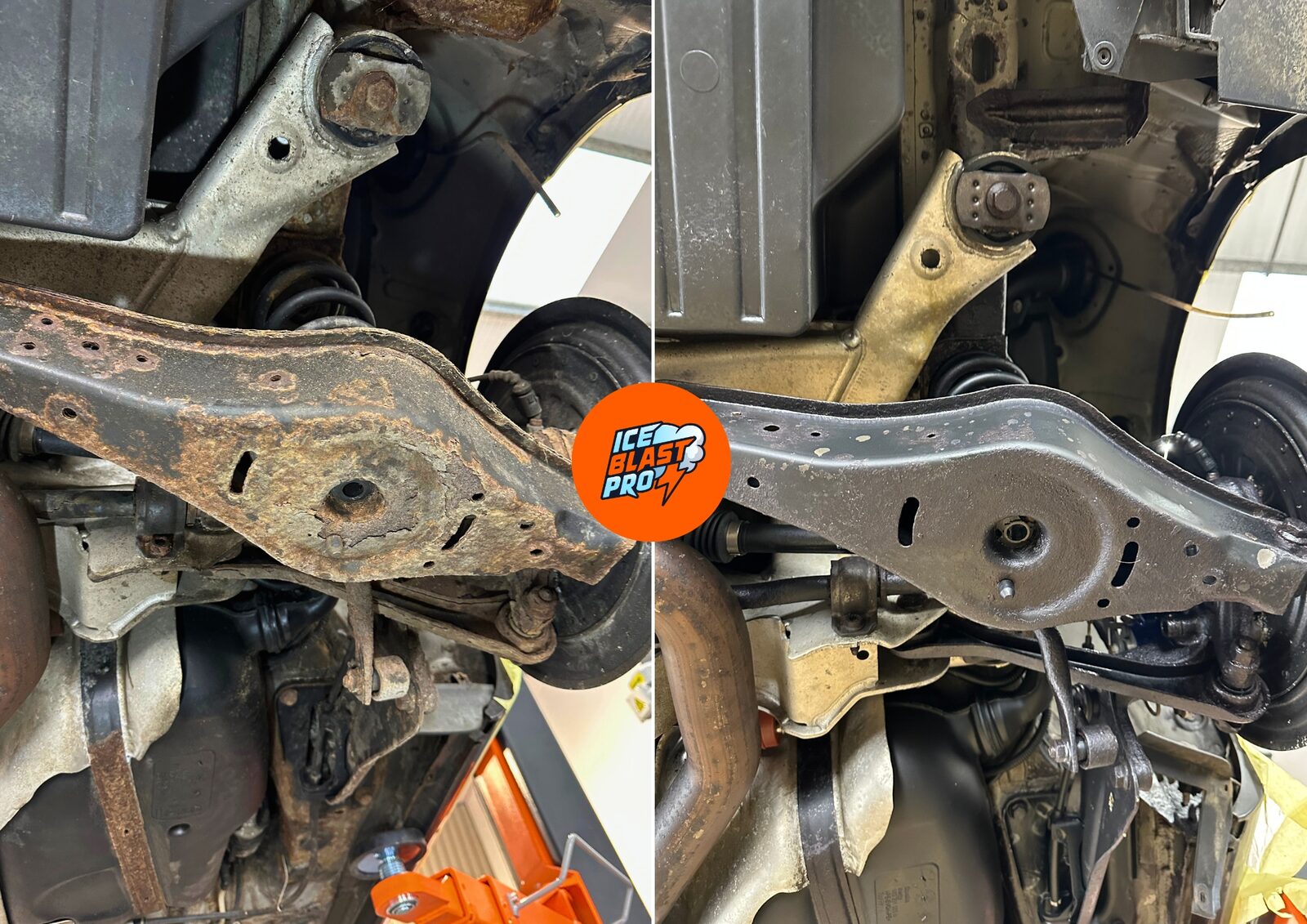
Dry ice blasting can remove loose surface corrosion, dirt, road salt and failing coatings, but it does not repair pitted metal, rebuild weak sections or reverse structural corrosion. For rust treatment, dry ice blasting should be seen as the preparation stage. It exposes the true condition of the metal so corrosion can be assessed properly.
If rust is present, the next step may be rust stabilisation, a rust converter, laser cleaning, localised repair, welding, cavity wax or a protective coating, depending on the severity. This is why dry ice blasting is so useful for underbody preservation – it reveals what is really happening underneath.
Does dry ice blasting damage car paint?
Dry ice blasting should not damage sound automotive paint when carried out correctly with the right pressure, nozzle, distance and technique. However, loose paint, failing coatings, weak underseal or already damaged finishes may lift during the process. If a coating comes away during dry ice blasting, it may already have been poorly bonded or failing.
On cars, the process should always be adjusted to the area being cleaned. Painted panels, wheel arches, factory coatings, alloy parts, rubber, plastics and engine bay components all need different levels of care.
Is dry ice blasting better than pressure washing?
For underbody preservation and engine bay cleaning, dry ice blasting is often better than pressure washing because it does not introduce water and does not leave the vehicle wet afterwards. Pressure washing can remove surface dirt, but it can also force water into seams, cavities and electrical areas where moisture may sit – which is not ideal when the next stage is rust treatment or protective coating.
Dry ice blasting is dry and leaves no secondary media behind, which makes it especially useful when the aim is inspection, preservation and preparation rather than just a quick clean. See the full comparison in dry ice blasting vs pressure washing.
Dry ice blasting vs steam cleaning
Steam cleaning can be effective for grease and dirt, but it uses heat and moisture. That can be useful in some situations, but it is less ideal where the surface needs to remain dry before corrosion treatment or protection. Dry ice blasting removes contamination without adding water, and for vehicle preservation that is one of its biggest advantages.
For the bigger picture across every method, read dry ice blasting vs pressure washing and steam cleaning.
Dry ice blasting vs sandblasting
Sandblasting is abrasive. It can be useful for heavy-duty stripping or bare metal restoration, but it can be too aggressive for many in-situ automotive areas. Dry ice blasting is non-abrasive when used correctly. It does not leave grit trapped in seams and does not strip sound material in the same way, which makes it better suited to cleaning underbodies, engine bays and mechanical assemblies where original finishes need to be preserved.
The right method depends on the job. Sandblasting may suit removed parts or full restoration work; dry ice blasting is better suited to careful cleaning and preservation. See dry ice blasting vs sandblasting for more detail.
What are the benefits of dry ice blasting on cars?
The main benefits are:
- No water added
- No sand, grit or secondary blasting media left behind
- Suitable for complex areas
- Useful around alloy, rubber, plastic and painted areas when used correctly
- Removes road salt, oil, grease and contamination
- Exposes the true condition of the underside
- Helps prepare for rust treatment and protection
- Improves inspection and documentation
- Reduces the need for aggressive scraping or wire wheeling
For classic, performance and prestige cars, the biggest benefit is not just appearance. It is controlled preparation.

What are the disadvantages of dry ice blasting?
The main disadvantages are cost, equipment requirements, dry ice supply, noise, ventilation requirements and the need for a trained operator. It is not always the fastest method for removing every coating: thick rubberised underseal, heavy bitumen, deeply bonded material or structural corrosion may need additional methods.
It also does not repair rust. It can expose corrosion and remove loose material, but deeper rust still needs treatment, stabilisation or repair. The result depends heavily on the operator, compressor, machine, nozzle choice, pressure and the condition of the vehicle.
How long does it take to dry ice blast the underside of a car?
The blasting itself may take several hours, but a proper underbody dry ice blasting and preservation project usually takes longer because of preparation, access, masking, inspection, rust treatment, protection and curing time.
A simple targeted clean may be completed relatively quickly. A full underbody and arches preservation programme may take several working days, because the aim is not just cleaning – it is inspection, treatment and protection.
How long does dry ice cleaning last?
Dry ice cleaning itself does not create long-term protection. It removes contamination and exposes the true condition of the surface. How long the result lasts depends on how the vehicle is used, stored and protected afterwards.
If the cleaned underbody is treated with rust stabiliser, cavity wax, clear protection or a longer-term coating, the result can last much longer than cleaning alone. Cleaning is the preparation; preservation is what protects the vehicle afterwards.
Can you do dry ice blasting yourself?
DIY dry ice blasting is possible in some situations, but full automotive underbody or engine bay work is not straightforward. You need a suitable machine, a large enough compressor, dry ice supply, correct nozzles, ventilation, protective equipment and enough experience to control pressure around sensitive car parts.
Car undersides include brake lines, fuel lines, wiring, rubber, plastics, labels, old coatings, seams and fragile components. Poor technique can damage finishes, miss hidden contamination or expose corrosion without treating it properly afterwards. For full underbody preservation, professional equipment and experience usually make a significant difference.
Dry ice safety and handling
Dry ice blasting is safe when it is carried out properly, but dry ice itself must be respected. It is extremely cold and it sublimates into carbon dioxide gas, so handling and ventilation matter as much as the cleaning technique. Professional work should always follow basic safety practice:
- Trained operators. The equipment, pressure and dry ice should be handled by someone experienced with the process.
- Ventilation. Because dry ice turns into CO2 gas, the work area must be well ventilated so carbon dioxide cannot build up, especially in enclosed or low spaces.
- PPE. Suitable gloves, eye protection and ear protection should be worn – dry ice can cause cold burns and the process is noisy.
- No bare-hand contact. Dry ice should never be touched with bare skin, as even brief contact can cause a cold burn.
- No airtight storage. Dry ice must never be sealed in an airtight container, because the gas it releases as it sublimates can build up dangerous pressure.
- No large amounts in enclosed spaces. Large quantities should not be used or stored in small, unventilated rooms where CO2 can displace breathable air.
These are the same principles a professional setup follows as standard, and they are a key reason full automotive dry ice blasting is best left to a properly equipped workshop rather than attempted with hired equipment in a closed garage.
How IceBlastPro uses dry ice blasting on cars
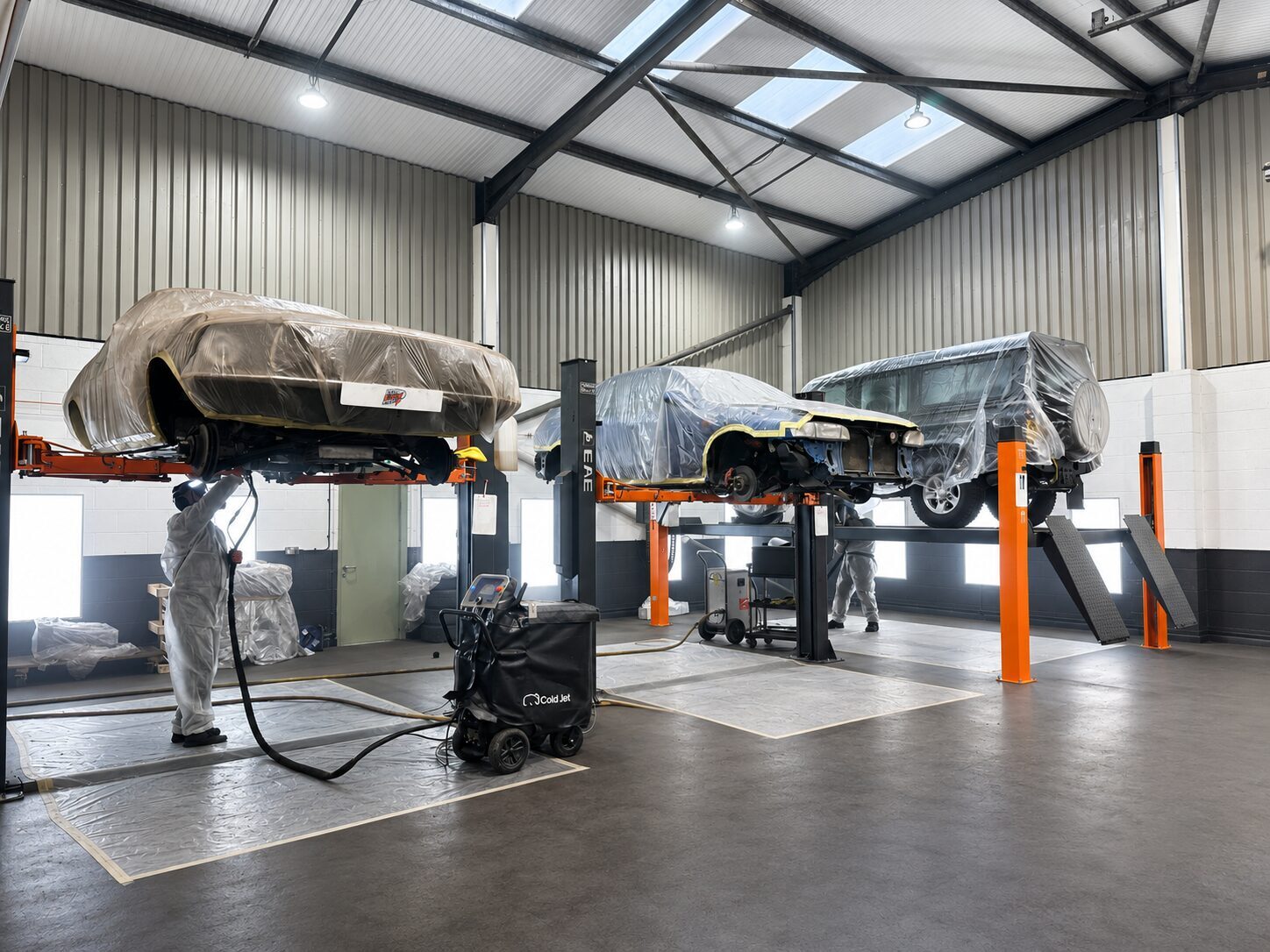
At IceBlastPro, dry ice blasting is usually part of a wider preservation process. We inspect the vehicle, protect the bodywork, remove wheels, liners and trays where required, dry ice blast the underside or engine bay, document the condition, treat corrosion where needed and apply suitable protection.
Depending on the vehicle, that may include clear protection, black underbody coating, cavity wax, rust stabilisation, laser cleaning or engine bay coating. The goal is not simply to make the vehicle look cleaner – it is to inspect, clean, treat, protect and document it properly.
What good preservation looks like.
A complete preservation programme, in five stages.
- Inspect
Before any tool is lifted, the underbody is assessed in detail. Test patches reveal what’s beneath the surface – so we know exactly what we’re working with.
- Pre-work assessment
- Test patches
- Condition review
- Clean
Dry ice and laser cleaning lift contamination, oil and failing coatings without water or abrasion. The car’s original surfaces are revealed, undamaged.
- Dry ice blasting
- Laser cleaning
- Treat
Corrosion is chemically stabilised. Weak metal is repaired or welded where required. Paint touch-ins happen here too – whatever the car needs to be sound again before protection begins.
- Rust treatment
- Chemical stabilisation
- Paint touch-ins
- Welding
- Protect
Only once the underlying work is done do the protection systems go on – matched to the vehicle, applied properly, and given the time to cure.
- Underseal
- Cavity wax
- Stone chip
- Document
Every stage is photographed and recorded. You collect the car with a treatment report and visual evidence of what was done – and what’s been preserved.
- Photo & video record
- Treatment report
Final thoughts
Dry ice blasting works on cars because it combines impact, extreme cold and sublimation to remove contamination without adding water or leaving blasting media behind. For underbodies, wheel arches, engine bays and mechanical components, that makes it a powerful preparation method.
But dry ice blasting is not a complete rust solution by itself. Its real value comes when it is used as part of a proper preservation process: inspect, clean, assess, treat, protect and document. If you want to know whether your vehicle is suitable, send us photos or a short underside video and we can advise on the right approach.
Common questions
What are three things you should never do with dry ice?
Never touch dry ice with bare hands, never store it in an airtight container, and never use or store large amounts in an enclosed space without ventilation.
What happens if you touch dry ice for one second?
Touching dry ice even briefly can be painful and may cause a cold burn, depending on contact time and skin sensitivity. It should always be handled with suitable gloves or tools.
Is dry ice 100% carbon dioxide?
Dry ice is the solid form of carbon dioxide. Commercial dry ice is made from CO2 and is used because it sublimates from solid directly into gas, leaving no water or residue behind.
Does dry ice have a smell?
Dry ice itself is solid carbon dioxide and does not normally have a strong smell. If there is an unusual smell during cleaning, it is usually from the contamination being removed rather than the dry ice itself.
Will dry ice melt in water?
Dry ice does not melt like normal ice. It sublimates, turning from solid carbon dioxide directly into gas. In water this happens quickly and creates a fog effect as the cold gas and water vapour interact.
How long does dry ice last?
It depends on whether it is pellets or a block, how much you have, the temperature, the container and how well it is insulated. Pellets used for blasting sublimate faster than larger blocks, so for professional work dry ice is treated as a time-sensitive consumable.
How much does dry ice cleaning cost in the UK?
Automotive dry ice cleaning costs vary by vehicle, access, condition and protection level. Targeted work may start from a few hundred pounds, while full underbody and preservation projects usually move into the low-to-mid four figures.
What is the hardest thing to clean off a car?
For underbody work, some of the hardest materials to remove are thick rubberised underseal, bitumen coatings, baked-on oil, heavy grease, old adhesive and layered previous coatings. These may need test patches, repeated passes or additional methods.
Does dry ice blasting remove dents from a car?
No. Dry ice blasting is a cleaning and preparation method, not a dent repair method. Dents should be handled by paintless dent repair or body repair specialists.
What is the silent killer in cars?
Rust is often called the silent killer because it can develop underneath a vehicle, behind arch liners, under old coatings or inside seams before the owner notices. Dry ice blasting helps by removing the dirt, salt and failed coatings that hide the real condition of the underside.
What is the best dry ice blaster on the market?
The best dry ice blaster depends on the work, but the machine is only one part of the setup. Compressor output, dry ice quality, nozzle choice, pressure control, technician experience, access and preservation knowledge all affect the result.
Are dry ice fumes harmful?
The fumes from dry ice are carbon dioxide gas. In a well-ventilated space this is not a problem, but in an enclosed or poorly ventilated area CO2 can build up and displace breathable air, which is why ventilation is essential during dry ice blasting.
What should you do if you have inhaled too much dry ice gas?
Move to fresh air immediately and seek medical advice if you feel unwell, dizzy, short of breath or confused. The risk comes from carbon dioxide reducing the oxygen you are breathing, so getting into fresh air is the priority.
Do I need gloves to handle dry ice?
Yes. Dry ice is around −79°C and can cause a cold burn on contact, so it should always be handled with suitable insulated gloves or proper tools, never with bare hands.
What PSI is needed for dry ice blasting?
Dry ice blasting runs on compressed air, and the working pressure is adjusted to the surface and contamination – lower for delicate painted, rubber or labelled areas, and higher for heavy chassis sections. Matching the pressure to the part matters more than any single number, which is why it should be set by an experienced operator.
What size dry ice is best for blasting?
Pellet size and density are matched to the job. Smaller, softer pellets are gentler for detailed or delicate areas, while denser pellets carry more energy for heavier contamination. The right choice depends on the surface and what is being removed.
Can you hire a dry ice blasting machine?
It is possible to hire dry ice blasting equipment, but automotive underbody and engine bay work also needs a large enough compressor, a dry ice supply, the right nozzles, ventilation, protective equipment and the experience to control pressure around brake lines, wiring and sensitive parts. For full preservation work, professional equipment and experience usually make the difference.
What are the alternatives to dry ice blasting?
Depending on the job, alternatives include pressure washing, steam cleaning, sandblasting, soda blasting, vapour blasting, laser cleaning, manual scraping and chemical cleaning. Each has trade-offs around water, abrasion, residue and how delicate the surface is.
Is laser cleaning better than dry ice blasting?
It depends on the job. Dry ice blasting is better for removing contamination and preparing larger underbody areas without water or grit. Laser cleaning can be better for targeted, localised pitted corrosion. They are often used together rather than as direct rivals.
Want to see what dry ice blasting could reveal underneath your car?
Send us your vehicle details, underside photos or a short video and we’ll advise whether it needs dry ice blasting, rust treatment, underbody preservation, engine bay cleaning or further inspection.
Get Instant Quote